
Herbal Drink for Men’s Fertility, What Actually Works?
The most effective herbal support for men’s fertility targets three measurable parameters — sperm count, sperm motility, and testosterone levels — all of which are directly affected by oxidative stress, cortisol elevation, and nutritional deficiencies. Ashwagandha, Shilajit, and Gokhru have the strongest clinical evidence for improving these parameters in men with fertility concerns. A study published in Fertility and Sterility found that ashwagandha supplementation significantly improved sperm concentration, motility, and testosterone levels in men with stress-associated infertility compared to placebo.
Why Male Fertility Is Declining — and Why India Is Particularly Affected
Male fertility has declined globally over the past three decades — sperm counts in urban men have dropped by over 50% since the 1970s according to a landmark meta-analysis. In India, the combination of heat exposure, chronic stress, nutritional gaps, sedentary work, and environmental endocrine disruptors creates a particularly challenging environment for male reproductive health.
The mechanisms are straightforward. Oxidative stress damages sperm DNA and reduces motility. Elevated cortisol suppresses the hypothalamic-pituitary-gonadal axis, lowering both testosterone and sperm production. Poor sleep prevents the nocturnal hormonal repair cycle in which reproductive hormones are synthesised. And nutritional deficiencies — particularly zinc, selenium, and Vitamin D — impair the enzymatic processes required for healthy sperm production.
The Herbs With the Strongest Evidence for Male Fertility
Ashwagandha
The most studied adaptogen for male reproductive health. Beyond its cortisol-reducing effects, ashwagandha has been shown in multiple clinical trials to directly improve sperm count, motility, and morphology. The mechanism involves reducing reactive oxygen species — the oxidative molecules that damage sperm DNA — alongside its hormonal effects. For men with stress-associated infertility specifically, the cortisol-testosterone pathway makes ashwagandha the single most important herb to include.
Shilajit
Shilajit’s fulvic acid complex improves mitochondrial function in sperm cells — motility is an energy-dependent process, and sperm with better mitochondrial function swim faster and survive longer. A clinical study found that Shilajit supplementation significantly improved total sperm count, motility, and normal sperm morphology in infertile men. It also raised testosterone and DHEAS levels, supporting the full hormonal environment required for healthy sperm production.
Gokhru (Tribulus terrestris)
Gokhru’s protodioscin content supports luteinising hormone activity, which directly stimulates testicular function — both testosterone production and spermatogenesis. It is widely used in Ayurvedic fertility practice and has clinical evidence supporting improvements in sperm parameters in oligospermic men.
White Musli (Safed Musli)
Classified in Ayurveda as a Vajikaran rasayana — a botanical specifically for male reproductive strength. White Musli’s saponins support sperm quality and reproductive stamina. It is traditionally prescribed for low sperm count and reduced sexual vitality and has contemporary phytochemical research supporting its reproductive effects.
Lifestyle Factors That Undermine Any Herbal Support
Herbal fertility support works within a broader context — if the foundational conditions are actively working against reproductive health, even the best herbs cannot fully compensate. The most common lifestyle factors that suppress male fertility in urban India are: chronic sleep under 6 hours, laptop heat on the lap for extended hours, tight synthetic clothing that raises scrotal temperature, alcohol consumption, and unmanaged work stress.
Addressing these alongside herbal support produces far better outcomes than herbs alone. Our post on the thyroid-gut-cortisol connection explains how systemic stress affects every hormonal system, including the reproductive axis.
Sensoriom Yoddha as Daily Fertility Support for Men
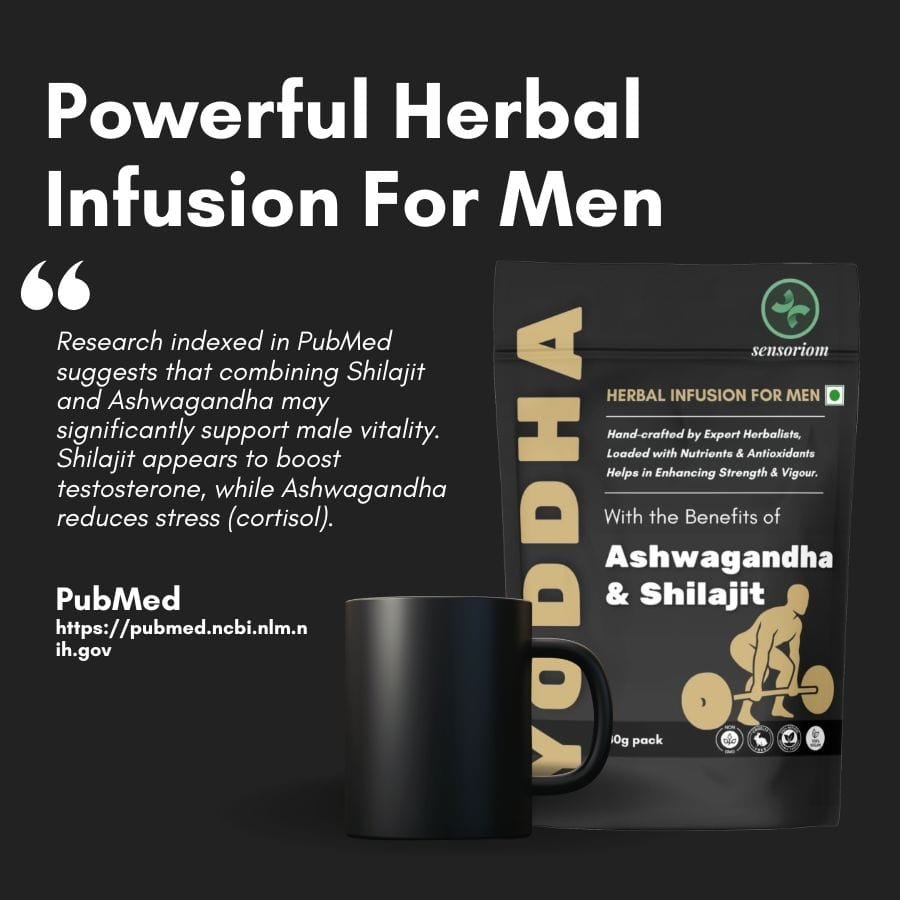
Sensoriom Yoddha brings together Ashwagandha, Shilajit, Gokhru, and White Musli — the four herbs with the strongest evidence for male reproductive health — in a single caffeine-free daily infusion. Ginger and Black Pepper improve circulation and the bioavailability of every active compound. Valerian Root supports the deep sleep in which hormonal repair and sperm production peak. Rooibos provides a powerful antioxidant base that reduces the oxidative stress that damages sperm DNA.
For men actively trying to conceive, consistent daily use over a minimum of 90 days is recommended — this aligns with the sperm production cycle, which takes approximately 74 days from spermatogenesis to mature sperm.
Frequently Asked Questions
Which herbs improve sperm count naturally?
Ashwagandha, Shilajit, and Gokhru have the strongest clinical evidence for improving sperm count and motility. They work through different mechanisms — cortisol reduction, mitochondrial support, and luteinising hormone stimulation respectively — making a combination more effective than any single herb alone.
How long does herbal treatment take to improve male fertility?
A minimum of 90 days of consistent daily use is required to see meaningful changes in sperm parameters — this matches the biological timeline of sperm production. Some improvements in hormonal environment, energy, and sleep may be noticed earlier, at 4–6 weeks.
Can stress cause male infertility?
Yes. Chronic cortisol elevation suppresses the hypothalamic-pituitary-gonadal axis — the hormonal chain that regulates testosterone and sperm production. Stress-associated male infertility is well-documented in clinical literature, and managing cortisol through adaptogens like ashwagandha is a validated approach to improving sperm parameters in this group.
This article is for informational purposes only and does not constitute medical advice. Please consult a qualified healthcare professional before making changes to your diet or health regimen.
Author: Dr. Navneet Goyal, MBBS, DNB | Harvard Business School | University of Geneva