Why Do Men Feel Tired After 40?
Men feel tired after 40 primarily because of three converging hormonal and metabolic shifts — testosterone levels begin a gradual decline from the mid-thirties onward, cortisol from accumulated chronic stress becomes harder to clear, and mitochondrial efficiency in cells decreases, meaning the body produces less energy from the same food and sleep input. None of these show up clearly on a routine blood report. And yet the cumulative effect is unmistakable — a fatigue that sleep no longer fully fixes, gym progress that stalls, and a mental flatness that was not there at 32.
What Is Actually Happening Biologically After 40
Testosterone in men declines at approximately 1–2% per year from age 35 onward. This is not dramatic enough to show as clinically low on a blood test, but it is enough to produce meaningful changes in energy, muscle mass, recovery capacity, and drive over a decade. The decline is gradual — which is why many men cannot pinpoint when it started. It just feels like ageing.
Simultaneously, the adrenal glands — which produce cortisol in response to stress — become less efficient at clearing cortisol after acute stress episodes. In a 25-year-old, cortisol spikes sharply in response to a difficult meeting and clears within hours. In a 42-year-old carrying years of accumulated stress, cortisol clears more slowly and baseline levels sit higher. Since cortisol and testosterone are inversely related, this chronic low-grade cortisol elevation accelerates the testosterone decline already happening with age.
The third factor — mitochondrial decline — is less discussed but equally important. Mitochondria are the energy-producing structures in every cell. After 40, mitochondrial density and efficiency decrease, meaning muscles and the brain produce less ATP from the same inputs. This is the biological reason why recovery takes longer, focus is harder to sustain, and the same workload feels more draining than it did a decade ago.
The Role of Sleep Disruption in Post-40 Fatigue
Sleep quality — not just duration — deteriorates significantly after 40. Deep sleep and REM sleep, the restorative stages where testosterone synthesis, cellular repair, and memory consolidation occur, reduce with age. Many men in their forties sleep 7 hours but wake feeling unrestored because the architecture of that sleep has shifted toward lighter stages.
This creates a self-reinforcing cycle: poor sleep raises cortisol, elevated cortisol further suppresses testosterone and disrupts sleep, and declining testosterone reduces the body’s ability to recover from stress. Breaking this cycle requires addressing sleep quality directly — not just sleep duration. Our post on why you wake up at 2–3 AM explains the cortisol-sleep architecture connection in detail.
What Helps — and What Does Not
More coffee does not help. It masks fatigue chemically while the underlying hormonal depletion continues. Intense exercise without adequate recovery worsens cortisol levels rather than improving them. Protein supplements address muscle but not the hormonal environment in which muscle is built and maintained.
What genuinely helps is addressing the three root causes simultaneously — reducing cortisol through adaptogens, supporting testosterone through targeted herbs, and improving mitochondrial function through compounds like Shilajit’s fulvic acid complex. Alongside this, prioritising sleep quality, managing the pace of work stress, and ensuring adequate Vitamin D levels — deficient in the majority of urban Indian men — make a measurable difference.
Sensoriom Yoddha: Formulated for Exactly This Stage of Life
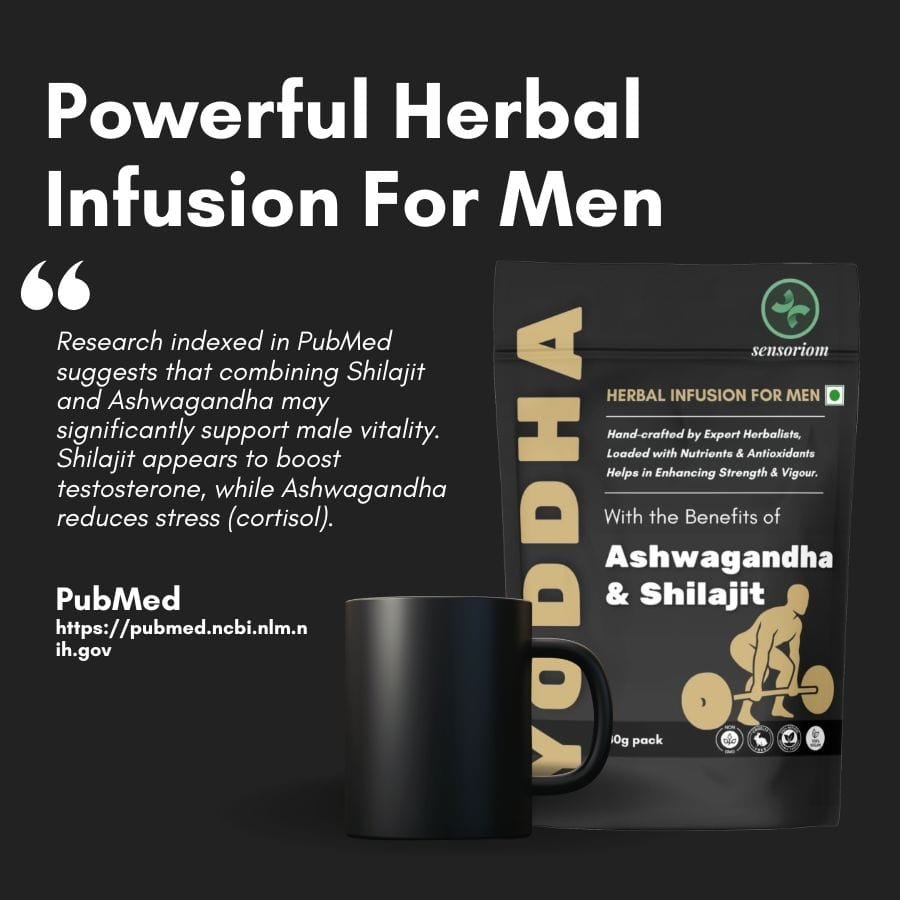
Sensoriom Yoddha is a twelve-herb caffeine-free infusion physician-formulated for the hormonal and metabolic reality of the Indian man after 35. Ashwagandha reduces cortisol through HPA axis modulation. Shilajit directly supports mitochondrial ATP production and has clinical evidence for testosterone support. Gokhru stimulates the luteinising hormone pathway. Valerian Root restores deep sleep architecture. Rooibos provides cellular antioxidant support that slows oxidative ageing. Pipli and Ginger enhance metabolic efficiency and herbal bioavailability.
It is a daily morning ritual, not a quick fix — the compounding hormonal and mitochondrial effects build meaningfully over 6–12 weeks of consistent use.
Frequently Asked Questions
Is it normal to feel constantly tired after 40?
It is common, but it is not inevitable or untreatable. The fatigue most men experience after 40 has identifiable causes — gradual testosterone decline, elevated cortisol, declining mitochondrial efficiency, and poor sleep architecture. Each of these can be meaningfully addressed through lifestyle changes and targeted herbal support.
Can low testosterone cause fatigue in men over 40?
Yes — testosterone plays a direct role in energy metabolism, muscle maintenance, and motivation. Even subclinical testosterone decline — levels within the normal range but at the lower end — can produce significant fatigue, especially when combined with chronically elevated cortisol and poor sleep quality.
What should a man over 40 drink for energy without caffeine?
Ashwagandha and Shilajit-based herbal infusions are the most evidence-backed caffeine-free options for sustained energy in men over 40. They work by restoring the hormonal and mitochondrial environment rather than stimulating the nervous system, which means the energy they support is durable rather than followed by a crash.
This article is for informational purposes only and does not constitute medical advice. Please consult a qualified healthcare professional before making changes to your diet or health regimen.
Author: Dr. Navneet Goyal, MBBS, DNB | Harvard Business School | University of Geneva